×
  • News
  • Reviews
  • Guides
  • Features
  • Videos
  • News
  • Reviews
  • Guides
  • Features
  • Videos
Log in / Register
REVIEW

Bravely Second: End Layer Review

by Sam Foxall, March 4th, 2016
  • Bravely Second: End Layer
  • Reviews
  • News & Features
  • Guides
  • Bravely Second: End Layer
  • Reviews
  • News & Features

Bravely Default acted as a shot in the arm for menu-based JRPGs, updating some creakier aspects of battle and reducing much of the bloat which has plagued this oldest of RPG combat systems. When a Bravely Default sequel was teased at the end of the first game, it became a question of whether this new age Final Fantasy would follow the spirit of the series which birthed it, keeping the battle system but changing the entire world or if it would opt for a straight sequel. Bravely Second takes the latter route, keeping many of the original cast members, having its adventure set in the same world but adding new jobs into the mix to bolster its already vast array of class combinations. What results is an RPG which straddles the line between familiar and stagnant, one which stays firmly in its comfort zone and doesn’t really step out of the territory it established in Bravely Default.

Bravely Second occurs two and a half years after the dimension-hopping antics of the first game, where a new threat has arisen to trouble the land of Luxendarc. You follow Yew, a young knight of the Crystalguard who is tasked with protecting Pope Agnes, one of the original four heroes of Bravely Default and head of the Crystal Orthodoxy. After Agnes is kidnapped by the mysterious Kaiser Oblivion and taken to his floating fortress, Yew sets out on a quest to take down the Kaiser and bring peace back to the land. In his quest, he is joined by Tiz and Edea, two other heroes from the first game as well as Magnolia, a soldier from the Moon who fell to Earth in her mission to hunt down the monster that destroyed her lunar home. The returning cast dominate the majority of the game, with Yew fading into the background as the plucky new guy who spends most of his time worshipping his hero Tiz. The clue is in the name, being a blank player avatar who is mainly there to watch the story unfold while the heroes from the last game do most of the heavy lifting. This will become a recurring theme with Bravely Second in that it is way too reluctant to nudge the old cast out of the limelight and chart its own story. The actual plot of following the Kaiser’s fortress all over the world has you travelling to the exact same locales in almost the exact same order as Bravely Default, battling bosses along the way that unlock new jobs. It even replicates the dimension hopping from the endgame of its predecessor but luckily, it does not have you fighting the same bosses up to six times in order to get the proper ending. The main plotline is functional but that’s about all the praise I can give it, as it follows the same story beats of Bravely Default almost to the letter.

This isn’t to say that it is bad, it just feels uninspired. Not only does the plot seem incredibly familiar, but the characters and individual storylines feel like an amalgamation of every JRPG trope under the sun. Each character has some kind of wacky tick, like Yew’s obsession with gravy or Magnolia’s random French outbursts while the villains fall into equally recognisable archetypes like the goth with the creepy dolls or the pretty boy who all the women fawn over. To some, it may feel comfortable and welcoming but if you are expecting Bravely Second to push the boat out as much as the original did, you’re in for some disappointment. Having said that, Bravely Second is a game that revels in its silliness and it’s all the better for it when it does. One of the classes you can equip turns you into a master of cats, there is a lunar colony where everyone speaks French for some unknown reason and there are pigs in every major town which have the power to warp you to cities you’ve already visited. As hinted at with the plethora of Yew and You jokes that never get old during the course of the main adventure, Bravely Second doesn’t so much lean on the fourth wall, as it does knock it down and start to build a kitchen extension. If you are a fan of dodgy puns, shonen anime stereotypes and constant fourth wall breaks, you’ll be having a wonderful time with Bravely Second but otherwise, you’ll become bored of the goody two-shoes heroes and the moustache-twirling villains by the time you reach hour ten.
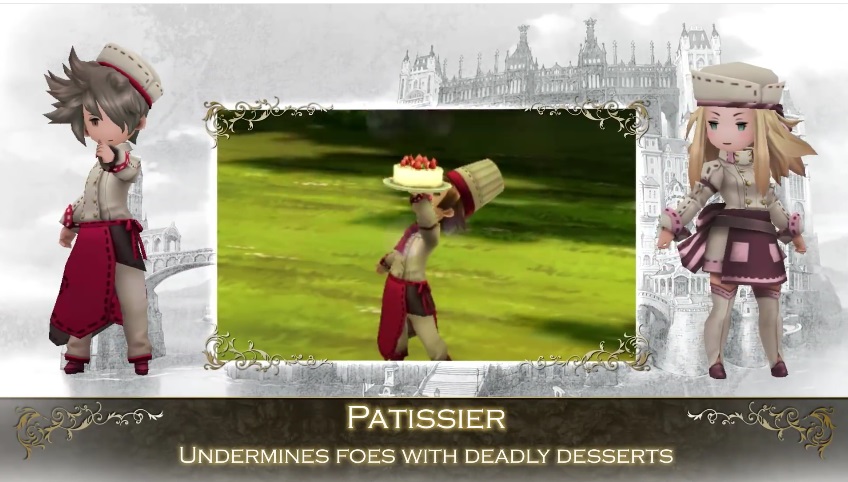
Being able to vanquish a dragon with a cream cake is certainly new to me.

For those who played the original, be prepared for a lot of déjà vu as you end up playing through many of the same dungeons from the first game for about the tenth time. You’d think they’d have had an interior decorator change some of the towns or dungeons but no, they are perfect matches of areas found in Bravely Default. Your mileage will vary depending on whether you are a veteran of the series or a new arrival but to me, the use of unaltered dungeons is just plain lazy. Many of the puzzles remain unchanged and while there are different enemies within, you can’t help but feel that this is more Bravely Default 1.5 rather than a full blown sequel with some proper effort put into it. Luckily, the new jobs add enough variation that the combat doesn’t feel completely stale. Most of the new jobs are interesting hybrids of pre-existing archetypes like the Wizard, which allows your standard elemental spells to be mixed with special parameters like attacking all enemies with the same name or converting magic damage into physical damage. Jobs like the Patissier occupy the weirder end of the spectrum, where you can use cakes and drinks to buff your fellow party members or do damage to your opponents by lighting them on fire like a flambé for example. You can unlock most of the classes from Bravely Default like your standard Black Mage, White Mage and Valkyrie but these require you to complete special sidequests where you must side with a character from the original game to triumph over another. These quests are framed as moral decisions, with one quest having you deciding between a natural spring being open to the public or the water being used to help build a possible superweapon/renewable energy source, with your final decision causing you to fight against a boss which will grant you one of the original jobs. The moral part of the decision fades into the background, as you only really care about what class you unlock and even if you make a supposed ‘bad’ decision, you can essentially redo your mistake when the dimension jumping comes back to the fore in the late game.

Moreover, the localisation of this game makes it that each ending to this sidequest is the equivalent to a neutral ending, where no-one really gets hurt and there is no consequence to your actual decision. Now, I’m not going to go off on the localisation like one of those anoraks who gets morally offended when a revealing costume gets taken out but it does add to the insubstantial nature of Bravely Second. The game is so risk averse that there is no real tension in the narrative, with the bad guys always getting their comeuppance and the heroes being paragons of goodness who always save the day. Again, if you are looking for a well-made JRPG to fill 40 hours of your time, Bravely Second will be your game but don’t expect it to be your game of the year. There are absolutely no real surprises as you play and almost every design decision from the original game returns for this one, for better or worse.

While new jobs have been added, the core combat is untouched from Bravely Default. The battles are governed by Brave Points, which determine how many actions a single character can perform in a turn. You can save up BP through Defaulting, which is the equivalent of a defend command from other RPGs or you can be Brave and use up extra BP to complete up to four actions in a single turn. Carefully spending extra actions will determine your success in battle, as some abilities use up BP instead of your magic points, meaning that you can quickly go into BP debt and have to wait multiple turns before your BP returns to zero and you can act again. Even the titular Bravely Second was in the original game, with it freezing time for a turn and allowing players to perform even more battle actions without enemies being able to react. Unfortunately, the same time limitation has been ported over from Bravely Default, where the creatively labelled ‘Second Points’ have to recharge in real time for them to be used again. You can spend real world money to buy more SP but you have to be a real chump to waste money on that. You can still speed up battles by using the Fast Forward commands to whizz through battle animations or even turn off random encounters all together if they get too much but nothing drastically new has been added to Bravely Second to make it feel like a proper sequel.

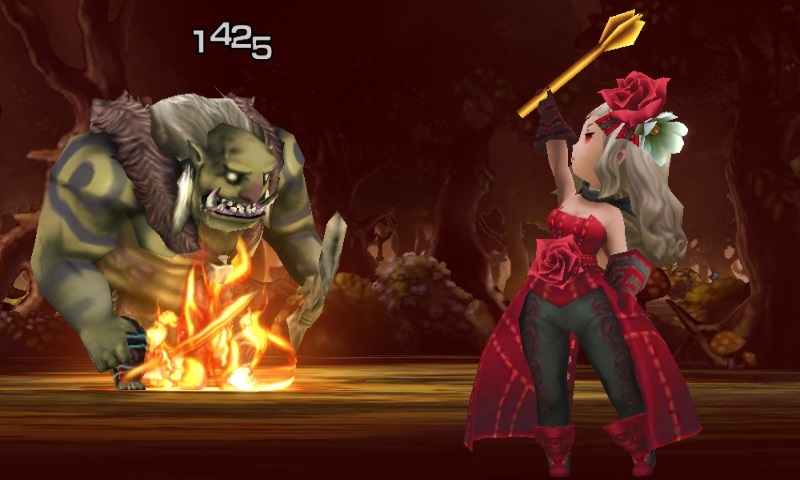
You do get your standard RPG monsters, alongside the crazy moon bugs that use neon umbrellas.

Even the boring town builder is back, where you now have to repair Magnolia’s moon base in order to unlock elements of your special moves. Like Second Points, the repairs to the moon base happen in real time and require players to leave their 3DS in Sleep Mode to have their buildings be repaired while you aren’t adventuring. This mechanic was an artificial time sink in the first game so I have absolutely no idea why it has returned in this one. Another time-wasting minigame is the newly added Chompcraft, which has your party members making plush toys to sell for currency which can eventually be swapped for in-game cash once you have completed enough of this Cookie Clicker-esque minigame. Like Cookie Clicker, it seems completely stupid at first but you soon become engrossed as you watch your party craft little monster toys and watch your Chomp Cash get higher and higher. I am sad to admit I have spent more than three hours playing this minigame, listening to the game’s amazing shop music and accomplishing nothing of note.

As with much of Bravely Second, the artstyle is the exact same mix of medieval fantasy and magical future technology that you’ve seen in Final Fantasy and other old school JRPGs. The monster designs range from your typical goblins and imps to robots with hidden weaponised trombones and glowing moon bugs so there is at least some variety in the enemies you face over the course of your adventure. Each job class has its own unique costume which go from the familiar white and red robe of a White Mage to the chaps and cowboy hat of the Hawkeye. There is nothing that will blow you away but it provides enough visual variation that you aren’t bored when fighting. The score of Bravely Second is equally as impressive as the original, with the battle themes hitting that perfect electronic rock sound which works every so well with JRPGs. The English voice acting is surprisingly passable, with the only real problem being with the sound mix which causes some distortion when anyone makes an ‘s’ or a ‘c’ sound. It doesn’t fix the cheesy script and groan-inducing puns but it’s rare to have an English voice cast that is actually better than the original Japanese.

Ultimately, I’m disappointed by Bravely Second. It is so resistant to taking a risk with its well-crafted battle system that it has you going on an adventure that lacks any tension and remains in the shadow of its successful older brother. Sure, it’s doesn’t have any massive problems but its refusal to take a punt on a new setting and lazily repeating dungeons and areas from Bravely Default that the two will blend into each other. If you never played the first one, you might as well go straight to Bravely Second but if you were a fan of the original, be prepared to play exactly the same game, just with a few new jobs and an endgame which isn’t as repetitive. It may be comfortable and inoffensive, but Bravely Second is a game that you will forget not long after finishing it.

7
A risk averse JRPG that is so scared to try something new that it never ascends past pretty good. Go straight to Bravely Second if you haven't played the first one and be prepared for disappointment if you loved Bravely Default and you were expecting something bigger and better.

Filed under: 3DS bravely second end layer Nintendo RPG Square Enix

The Outer Worlds Gets Switch Release Date, June 5th + Day One Patch
Oninaki Review
GreedFall Gets Release Date and Trailer
Nintendo Switch Lite Details Revealed
Square Enix E3 2019
E3 2019: Square Enix Conference Roundup
A look into Warhammer Fantasy Roleplay: Starter Set
Yoshi's Crafted World
Yoshi’s Crafted World Review
The Game Awards
5 Games That Could Be Announced At The Game Awards 2018
Labyrinth of Refrain: Coven of Dusk Review
Powered by Magic
  • VGU
  • Platforms
  • Features
  • Reviews
  • Games

© 2025 VGU.

Insert/edit link

Enter the destination URL

Or link to existing content

    No search term specified. Showing recent items. Search or use up and down arrow keys to select an item.