
×
  • News
  • Reviews
  • Guides
  • Features
  • Videos
  • News
  • Reviews
  • Guides
  • Features
  • Videos
Log in / Register
REVIEW

Phoenix Wright: Ace Attorney – Spirits of Justice Review

by Rob Pritchard, September 19th, 2016
  • Phoenix Wright: Ace Attorney – Spirit of Justice
  • Reviews
  • News & Features
  • Guides
  • Phoenix Wright: Ace Attorney – Spirit of Justice
  • Reviews
  • News & Features

The Ace Attorney series has gone from strength to strength since it originally arrived on English shores back in 2005 for the Nintendo DS. It spawned several sequels and spin offs, including an investigation game starring prosecutor Miles Edgeworth, and a crossover adventure game that ties together with gaming’s first puzzle solving gentleman Professor Layton. After a brief rest following 2013’s Dual Destinies, Phoenix Wright has returned to the bar once again in Ace Attorney: Spirits of Justice. This time around, our spiky haired lawyer is faced with a danger that is far stronger than the “Dark Age of the Law”, a phenomenon which he helped to vanquish in the previous game.

The story begins with Phoenix Wright travelling to the kingdom of Khura’in to visit his long time friend Maya Fey, a spirit medium in training. During his visit, his tour guide is accused of murder and his guilt is seemingly proven by a séance performed by the Royal Priestess. Unable to see his new friend suffer, Phoenix takes to defend him in court, unaware of the prejudice that exists in the country towards defense attorneys, and the penalties that exist to those who dare to defend their guilty clients. Meanwhile, Apollo Justice is also defending clients back at the Wright Anything Agency established by Phoenix, along with Dual Destinies protagonist Athena Cykes, and his half-sister Trucy Wright.

Ace Attorney: Spirits of Justice is divided into five separate chapters, with each set of main characters receiving two cases in the spotlight, and they are all brought together for the final adventure. Like each of the previous Ace Attorney games, each chapter, known as a Turnabout is separated into trial and investigation segments. The aim of each chapter is to defend your client using the evidence available and find the true culprit of each crime by cross examining the witnesses that the prosecution presents to the court. Many fans complained that the difficulty of the puzzles and cross examination within Dual Destinies was slightly too easy, but the same cannot be said of Ace Attorney: Spirits of Justice.
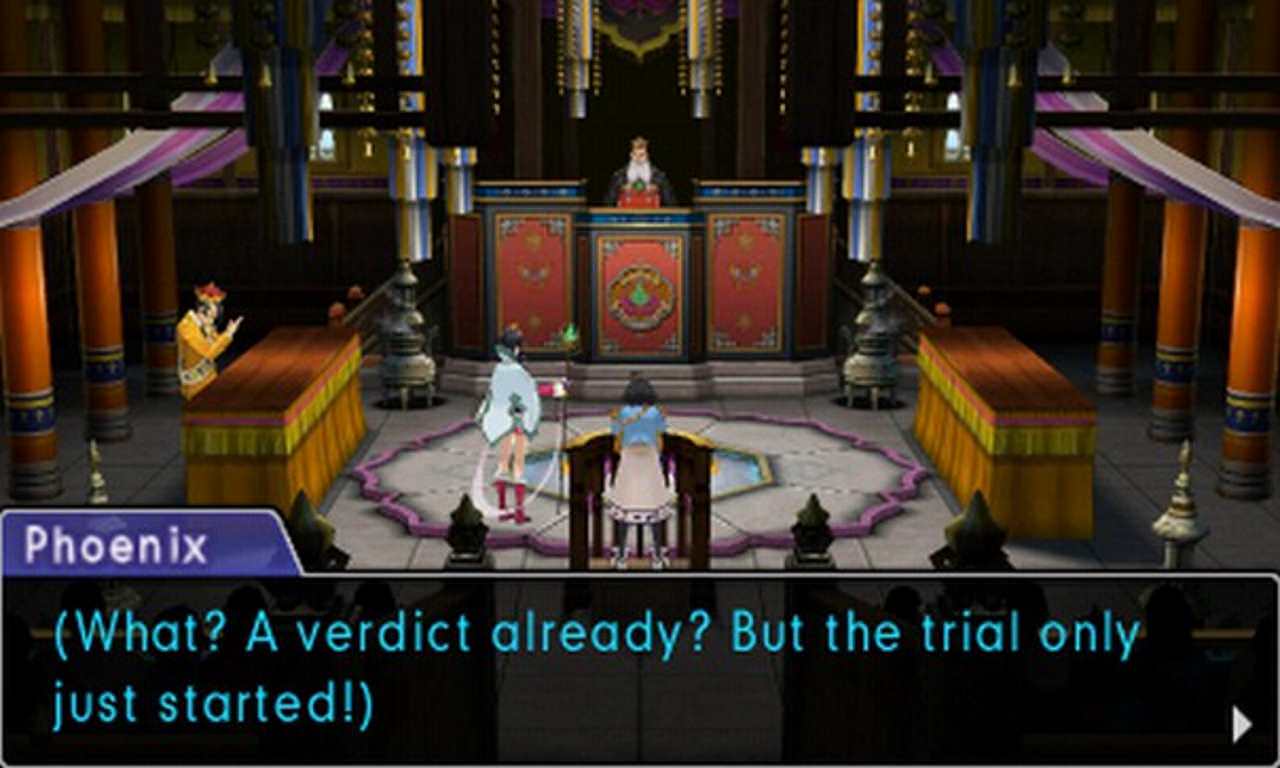

The five strike system from the original game has returned, instead of the health bar system that was present from the second game onwards. The return of a fixed penalty system works well within the context of the Khura’in law system, especially when the prosecution claim to be able to tell the secrets of the recently departed. These strikes are not restored by correctly progressing through each case, so you will need to either save often, or examine every piece of evidence with a fine tooth comb. Each of the defense lawyers unique talents return for the cases, which is always welcome within the compelling but sometimes long winded dialogue between the characters in and out of court.

Phoenix is able to break through Psyche Locks with his Magatama pendant, Apollo is able to use his bracelet to see through a witness’s poker face and Athena uses analytical psychology to determine out of place emotions with her robotic partner Widget. All three methods work well to find obtain vital information in a testimony, but Apollo’s ability requires pin point precision in order to proceed, which can sometimes lead to an incorrect accusation at the worst possible time. When you are not forced to rely on their special talents, the puzzles related to finding evidence to support your client’s defense are much harder than the previous instalment, which had been criticised for holding your hand on several occasions. This is especially true at the end of the first case, where you have to locate where a particular person would have to be standing for your story to be considered plausible.

One of the strongest elements of the Ace Attorney games has always been their weird and wonderful casts. In the past, they have ranged from reclusive TV stars who have been wrongly accused, to single minded prosecutors determined to get their verdict, and even deranged ex-girlfriends who return from the dead for revenge. This time around, the cast is just as vibrant, with the English translation team providing high quality pun-filled names that will make you both laugh and cringe at the same time. Quite possibly one of the best examples of this is the head monk Pees’lubn Andistan’dhin, whose seemingly innocent hippy demeanour is shattered considerably once you realise his true intentions. The only small chink in the armour is that one character has a style of dialogue that is inconsistent with his character’s appearance, which slightly broke the suspense of reality for me for a brief moment.

From a graphical perspective, Capcom have opted to use the same 3D cel shaded visual style that was used in Dual Destinies, which was a distinct improvement over the sometimes bland sprite work from the previous instalments. The animations have received a definite upgrade, feeling much less wooden and more expressive than before. The anime cut scenes have also returned, and this time they have been animated by A-1 Pictures, the producers of the recently released Ace Attorney anime.  The soundtrack of the Ace Attorney series has always struck a memorable chord, and Spirit of Justice is definitely of this accolade. Some of the old classic tunes such as the Cornered theme return with a new twist, whilst a new set of high energy tones have been added to suit the courtroom mood, along with a few slow paced oriental ballads to suit the oriental theme of Khura’in. Some of the voice actors who offered their talents in previous games, such as Sam Reigel, Wendee Lee and Troy Baker have returned for the latest instalment, along with a few newcomers who offer equally professional performances for new and returning characters.

Overall, Ace Attorney: Spirits of Justice continues the proud traditions set by the previous games in the series, whilst providing some unique twists of its own with the Divination Séance system. The alternating storyline of Phoenix and Apollo keeps things from becoming stale, and the improved puzzle system means that even accomplished Ace Attorney fans will need to consult their Court Records extensively to get through each case. Although there is one case where the dialogue feels slightly out of context, the sixth entry in the Phoenix Wright series raises very few objections that would require Capcom to revise its gaming testimony.

8
The latest entry in the Ace Attorney series provides the same addictive gameplay and immersive story as the previous instalments. Despite a few flaws, Phoenix Wright: Ace Attorney - Spirits of Justice is a visual novel experience that stands proud among it's ancestors.

Filed under: Ace Attorney: Spirits of Justice Phoenix Wright: Ace Attorney - Spirits of Justice

Powered by Magic
  • VGU
  • Platforms
  • Features
  • Reviews
  • Games

© 2025 VGU.

Insert/edit link

Enter the destination URL

Or link to existing content

    No search term specified. Showing recent items. Search or use up and down arrow keys to select an item.