×
  • News
  • Reviews
  • Guides
  • Features
  • Videos
  • News
  • Reviews
  • Guides
  • Features
  • Videos
Log in / Register
REVIEW

Operation Abyss New Tokyo Legacy Review

by Rob Pritchard, June 13th, 2015
  • Operation Abyss New Tokyo Legacy
  • Reviews
  • News & Features
  • Guides
  • Operation Abyss New Tokyo Legacy
  • Reviews
  • News & Features

Secret societies that protect the human race from monsters are a common plot device in video games, more often than not requiring you to harness superhuman abilities to keep the world safe. Operation Abyss New Tokyo Legacy has taken this concept, and placed it within a fictional modern day Japan. After waking up in a sewer with no idea how you arrived there, you are rescued by the XSith Squad, an elite group of individuals that exterminate monsters known as Variants to protect the world from total destruction.

After being enlisted in the group yourself by the leader Captain Alice, you are trained in the arts of surveillance and using a power known as Code Rise to inherit superhuman abilities such as enhanced strength, flight and magical spells. Although you are a part of the organisation, you also do attend the high school in which the XSith squad is based, although you never actually attend any lessons.


Sounds more like the name of a GCSE than a magic spell.

Operation Abyss is for the most part an RPG with visual novel elements, similar to Atlus’s Persona or Spike Chunsoft’s Danganronpa. Played entirely from a first person perspective, the only glimpse you get of the character is in the customisation screens. The art style of the environments, characters and items are traditionally shaded manga, with extra detail such as shading and shadows given to the playable characters when you get brief glimpse of them.

In a possible nod to the dungeon crawler Etrian Odyssey, you can choose to play with pre-made characters that have been given a blood ancestor from which they inherit abilities similar to those in a traditional RPG class, such as Florence Nightingale who is a healer, and Himiko, who is a spell caster. If playing with randomised characters does not take your fancy, you can build your fighters from scratch and choose their blood ancestor for yourself. These two options are welcome, as they allow RPG players of all skill levels to experience the game.

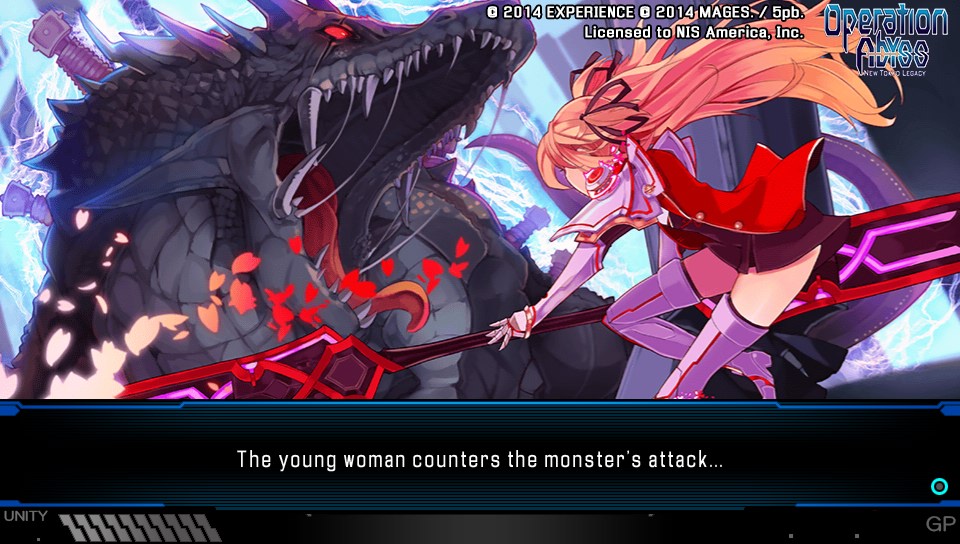
Once you have received a mission from Captain Alice, you will be able to venture into the game’s many labyrinths. These areas appear in many places, such as the top of a high rise building, the middle of a communal park or the depths of a suburban sewer. Within these spaces, Variants run free, appearing through random encounters or event spaces placed throughout the game world. Each member of your party can only perform particular actions based on its blood ancestor, so it takes some time to get used to the skills of a Scholar such as lock picking and detecting enemy statistics, compared to that of a melee fighter who will use close range attacks and stat increasing magic spells.

I’m sure I will Kyoko.

In particular, the many secret pathways within the game can be detected by most fighters, but only those with specific blood ancestors can break through the locks that require more than a conveniently placed lever. Outside of the labyrinths, you can wander around selected areas of Tokyo using visual novel style navigation tools, and interact with various individuals that you encounter. For the most part, the NPCs that you meet around the several locations have well written dialogue, and as a result are quite interesting to meet.

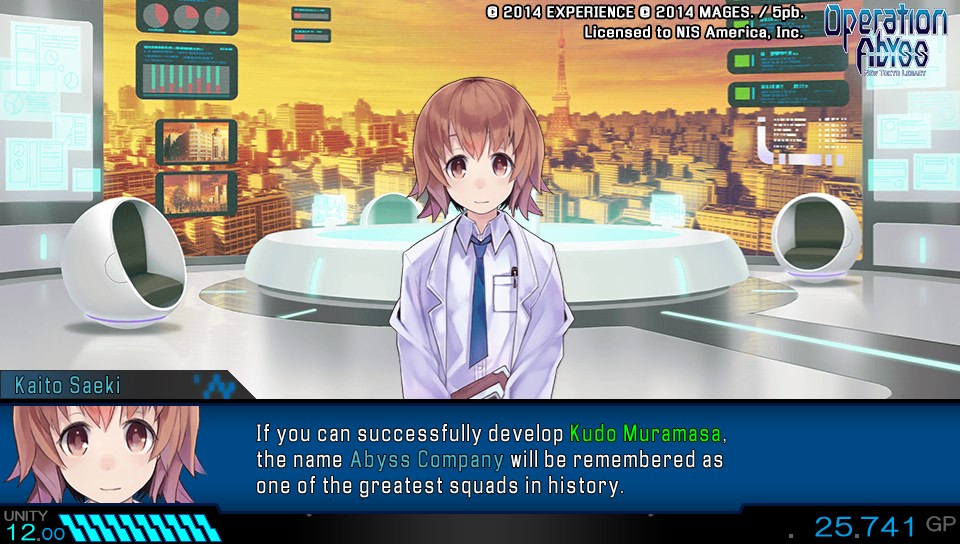
These include Johnny the stand-up comedian, whose pun laden quips make you laugh in spite of yourself, and Takuma the Peach Research club president whose antagonistic narcissism leads you to instantly distrust him. If I had to pick a less than stellar character, it would definitely be Kaito the lab assistant. His presence in the game is merely to be a speaking tutorial, and he explains things at such a length that it would make Omochao or Navi blush with embarrassment.

Instead of equipping your character with traditional weapons or armour, the Code Rise abilities held by the protagonists allow you to create an almost infinite amount of characters using Blood Codes. These items are like Technical Machines in the Pokémon series, in that they give your characters a specific bonus that will help them defeat the Variants. These codes can range from increasing the amount of hit points that the character possesses, or a new ability that can blow away all the on screen enemies with a wave of their hand.

I tried really hard to like Kaito, but his way of talking did little to convince me.

One of my favourite things about the game are the Code Chips that are found in the dungeons or the shops you can visit within the city. When you find one, each of your party members tries to detect what kind of trap prevents you from getting inside. If you choose incorrectly, there is a possibility that the character you nominate to break the lock will be punished in some form, such as an electric shock or a draining fear state that will reduce your health.

Unlike many games of its kind, there is one flaw that I find very difficult to forgive. Although it is commonplace to use the confirm button to skip through dialogue and to select actions in the battle screens, the same cannot be said for passing every piece of dialogue to perform your move once the attacking phase has begun. For example, in order for an enemy to hit you, you need to press the confirm button. There appears to be no way to override this in the Settings menu, nor is there a fast forward setting to make this error less prominent in the mind of the player.

From a musical standpoint, Operation Abyss has a solid soundtrack with a few memorable compositions, such as the opening theme and when you encounter a Variant in the dungeon areas. The voice acting varies from strong to slightly weak in places, and to my slight surprise, contains an English dub track, which is unusual for import RPG released on the PlayStation Vita. For fans of the original dub, it has been unfortunately been omitted from the western release.


After this incident, it was fair to say that the DC Comics crossover deal was off the table.

Overall, Operation Abyss is a good RPG, but has a couple of issues that prevent it from being truly memorable. The blood ancestor systems and trap defusing mechanisms add a substantial layer of depth to the mechanics, and the top tier soundtrack keeps the action moving, even when you are trailing through the battles by pressing the confirm button at regular intervals.

6
Operation Abyss offers a strong story and near endless customization. If you can ignore the small faults, it is an adventure that is worth your time.

Filed under: New Tokyo Legacy Operation Abyss RPG vita

The Outer Worlds Gets Switch Release Date, June 5th + Day One Patch
Oninaki Review
GreedFall Gets Release Date and Trailer
A look into Warhammer Fantasy Roleplay: Starter Set
The Game Awards
5 Games That Could Be Announced At The Game Awards 2018
Labyrinth of Refrain: Coven of Dusk Review
Divinity: Original Sin II – Definitive Edition Review
Code Vein Release Date Announced, Plus Collector’s Edition Explained
ELEX Review
Powered by Magic
  • VGU
  • Platforms
  • Features
  • Reviews
  • Games

© 2025 VGU.

Insert/edit link

Enter the destination URL

Or link to existing content

    No search term specified. Showing recent items. Search or use up and down arrow keys to select an item.